Monday, March 12, 2018

The Mysterious Grave Marker on CofC Campus!


Located right outside of the Robert Scott Small
building, lies this die on socket grave marker.

When walking on a college campus, one would not think to see a tombstone. Not just see it, but that says there is someone buried near it.

 At College of Charleston, there is a grave marker that states that Andrew Jackson's mother, Elizabeth Jackson, is buried near the Robert Scott Small Building in Cougar Mall! Why is it on the College of Charleston campus? That's the question that has yet to be answered.

At the College of Charleston campus, there are many people who pass the grave marker, faculty, students, and tourists. This may be one of the main reasons why it is here on campus. The placing of it seems kind of strange, but people will read it to see what it's all about. Even people may look up more details on it to see if she is actually buried by the grave marker.

Andrew Jackson never knew exactly where is mother was buried. She died near Charleston from cholera in 1781 because she tried to aid to Patriot prisoners of war that were held on the ships in the Charleston Harbor. Andrew Jackson asked James H. Witherspoon to give him some information on his mother's death location and how she died. His response to him was:
"Your Mother was buried in the suburbs of Charleston, about one mile from what was then called the Governor's Gate, which is in and about the forks of the Meeting and Kingstree Roads."

Andrew Jackson was never able to find where she was buried, but there are monuments that are dedicated to her and one of them includes the one here on campus. This is likely to be the most close to where she was actually buried, but there is no proof of it being here on campus as the tombstone says so. 
    
Here is another memorial for Elizabeth Jackson,
located at Old Wazaw Presbyterian Church Cemetery.

There still is no definite reason as to why there is a "memorial" for Elizabeth Jackson on the College of Charleston campus. I believe that it was because of the history of Charleston, and adding it to our campus made it more interesting for anyone who passes by it. It is probably believed that she is buried by the place that it is, but if someone is interested enough, they will do some research on it!


The other memorial dedicated to her in Charleston, SC.


Works cited:
https://www.postandcourier.com/columnists/behre-column-this-history-is-a-mystery/article_f0a6388f-dac2-5f25-ab58-2246049e150d.html

https://www.findagrave.com/memorial/10225235/elizabeth-jackson

http://www.strangehistory.org/cms/index.php/popular/93-elizabeth-hutchinson-jackson-the-missing-matron

http://www.waymarking.com/waymarks/WM4HNV_Elizabeth_Hutchinson_Jackson_Charleston_South_Carolina

Monday, February 26, 2018

Astonishing Visit to Bethel United Methodist Church!

Sue Bennett giving us background history of
Bethel United Methodist Church.
Our class heads out for another graveyard adventure to Bethel United Methodist Church! Not only did we see the graveyard, but the wonderful Sue Bennett took us into the church as well! We got to see the sanctuary, as well as some behind the scenes of the historical side of the church.

Bennett is a Charleston tour guide and she has her own website that you can find here! She knows a lot about Charleston history and loves sharing it with people! She also works at Bethel United Methodist Church as an administrator and gave us a tour of her own workplace!

Bennett shared with us, "This is in the 1850s, church members may own enslaved people, church pastors may not." I thought this was interesting because I figured that everyone could own slaves during this time.

She follows up her statement with, "What happens when a pastor's wife dies, he marries a lady who is a widow, who owns two enslaved people? She becomes his property as well as the enslaved people... Therefore with that and many other things going on, Bethel Methodist Episcopal Church becomes Methodist Church South." This is the church we went to February 19!
Inside of the church and our view from the
balcony. Suchan amazing view!


As we continued our tour, Bennett took us inside of the church and it was astonishing! The church is very different from our modern churches, so anyone could tell that it has history behind it. Bennet tells us, "[The church] would look very similar to what you see now, [from back then]."


After we took our tour, our class was to take pictures of some grave markers and identify the symbolism and what type of grave marker of each one. There were many to choose from, but we chose 10 of them to use for our blog posts.


This particular grave marker was William
H. Fleming D.D, a pastor at the
church in 1870.


This grave marker is considered a cradle because of the small walls outlining the grave. On the top part, there is a Bible on top of a podium and this usually symbolizes a person's good deeds. It also can symbolize that this person was very religious.

In this case, the man buried here was very religious because he was the pastor of the church. He died of gangrene lungs on April 16, 1877. He was born in Charleston county and died in Charleston county, being the minister of this church for 36 years in total.


This is one of the headstones laid on the wall
because of the earthquake that happened in 1886.


The woman who lies here is Priscilla Sarah Eason, born on June 28, 1809, died March 10, 1885. This type of grave marker is a headstone. The crown on the cross represents victory and Christianity.


Another headstone laid on the wall with
beautiful symbolism.


This dove represents a messenger of God, as well as peace. This woman, Elizabeth M. Ainger, was born on October 14, 1807, and died October 6, 1872. This headstone shows that she was a mother and the symbolism was meant to show that she is laying at rest, in peace.


Elizabeth M. who aged to be 65 years old and
she died in her sleep.
A close up to be able to see the detail of the
angel and all of the symbolism.

     Here is a headstone with an angel with her hand on her heart. This symbolizes a guide to heaven. This type of grave marker is a headstone that was possibly standing at one point and now it lies like a ledger. There is so much more symbolism shown on this grave marker.


James F.M. Lord, who died on February 16,
1862. He died at the age of 37.


This is another headstone with a weeping willow. The weeping willow symbolizes sadness and mourning. Even the name of the tree represents sadness. This is a beautiful, heart touching grave marker found at the church.


This very small headstone is one of the grave
markers that was saved due to the pave over
of the parking lot, along with many other ones. 


The finger pointing up on this headstone represents the hope of heaven. Even though it is very small, it shows a lot of symbolism. Casey Poyas's headstone was placed against the wall, but it was placed as close to the grave as possible, as Bennett told us.


The font of the words are hand carved and look more fancy
than other grave markers. This is another way to see that
an England carver made this.


This particular headstone was carved by someone in England. These designs are usually done by the carvers in England. We were told this from Ruth Miller in our past class on February 12.

The angel head with the wings beside it represents emerging triumphant from death. It is also known as the Death's Head.


Capt. Joseph Hunt is buried here and died
January 12, 1822 at the age of 45.


There are multiple types of symbolism on this headstone, but the urn is the base of the tree and it represents mourning. As before, the weeping willow represents sadness. These two together make the symbolism more powerful and meaningful


Charles C. Seyle, born July 12, 1823, died
February 10, 1880.


The thorns around the cross represent the suffering of Christ for our sins. This is a headstone that cracked and was probably standing at one point, but is laid down due to natural disaster.


Eva Lee, died on September 17, 1893, died
at the age of 26.


This die on base has a beautiful flower plant with a broken stem on the bottom right. The broken stem represents that someone has died at a young age. This woman died at a very young age, 26.


Rosa Mary, born October 9, 1835, died
November 2, 1881.


This drapery cloth symbolizes mourning and sorrow. The type of grave marker is a die in socket. There is also an arrangement of flowers on the grave marker and this represents love and grief.

There is a quote at the bottom that reads, "A brighter home than ours, in heaven, is now thine own." This is so beautiful and thoughtful for the woman who is laid here.


This visit was very interesting and we learned so much about the church, thanks to Sue Bennett! For any other details on the Bethel United Methodist Church graveyard click here!

Works cited:
Santore, Beth. “Gravestone Symbolism.” Gravestone Symbolism, www.graveaddiction.com/symbol.html.

Neighbors, Joy. “A Grave Interest.” Blogspot, 9 Sept. 2011, agraveinterest.blogspot.com/2011/09/symbols-flowers-and-frailty-of-life.html.

Monday, February 19, 2018

Charleston Graveyard History from the Remarkable Ruth Miller!

Charleston has so much intriguing history! Our class had the chance to hear the history from the woman who knows it as well as the back of her hand, Miss Ruth Miller! Ruth Miller came to visit our class last Monday and shared what she knows best, Charleston graveyards! She is a wonderful Charleston tour guide and has been since 1979! For more information on her, click on this link!
Ruth Miller's presentation on Charleston
graveyards and the history of them.

From the beginning, when Ashley Cooper and John Locke were encouraging people to live in Charleston. To the graveyards of Charleston that we know today! Ruth Miller explained to us how Charleston came about. She also explained to us how graveyards are significant now, as they were in the past through historical context! There were a couple of things that stood out to me and I thought were interesting during this lecture.

The three incentives that attracted settlers to Charleston by Lord Ashley Cooper were:
1. Free Land- where any man who came to the colonies were given land to white men.
2. Titled nobles- the declaration of the eight proprietors (Lord Ashley being one), gave them the right to settle the colonies and give acres to each man.
3. Freedom of religion (this is what helped churches come about in Charleston), for a religion to come about, it only took 7 people.
These three incentives are the foundation of Charleston and how it grew and continued to grow within the 1660s.

"There is no segregation in our churches before the Civil War." To think that there was no segregation before the Civil War is interesting. I did not know of this until Miller spoke to us. African Americans didn’t have the same rights as white men, but there was still no segregation. The African Americans had to sit upstairs in the balcony of the churches.

One of the things that Miller stated was "African Americans were never buried in a churchyard properly." It is obvious that during this time period that this would be accurate, but I thought that it was sad. There are no graveyards in Charleston that have African Americans with a labeled grave marker. This is very heartbreaking for families with ancestors who lived and died in Charleston that they may have known of.

If there were any African Americans buried in the churchyard, they would eventually get paved over, just to be forgotten. It is awful that this was something going on during the time period, but I believe that this was definitely one of the things that stood out to me. It was unfair for the African Americans. Even in churchyards now, you will not see an African American grave marker.
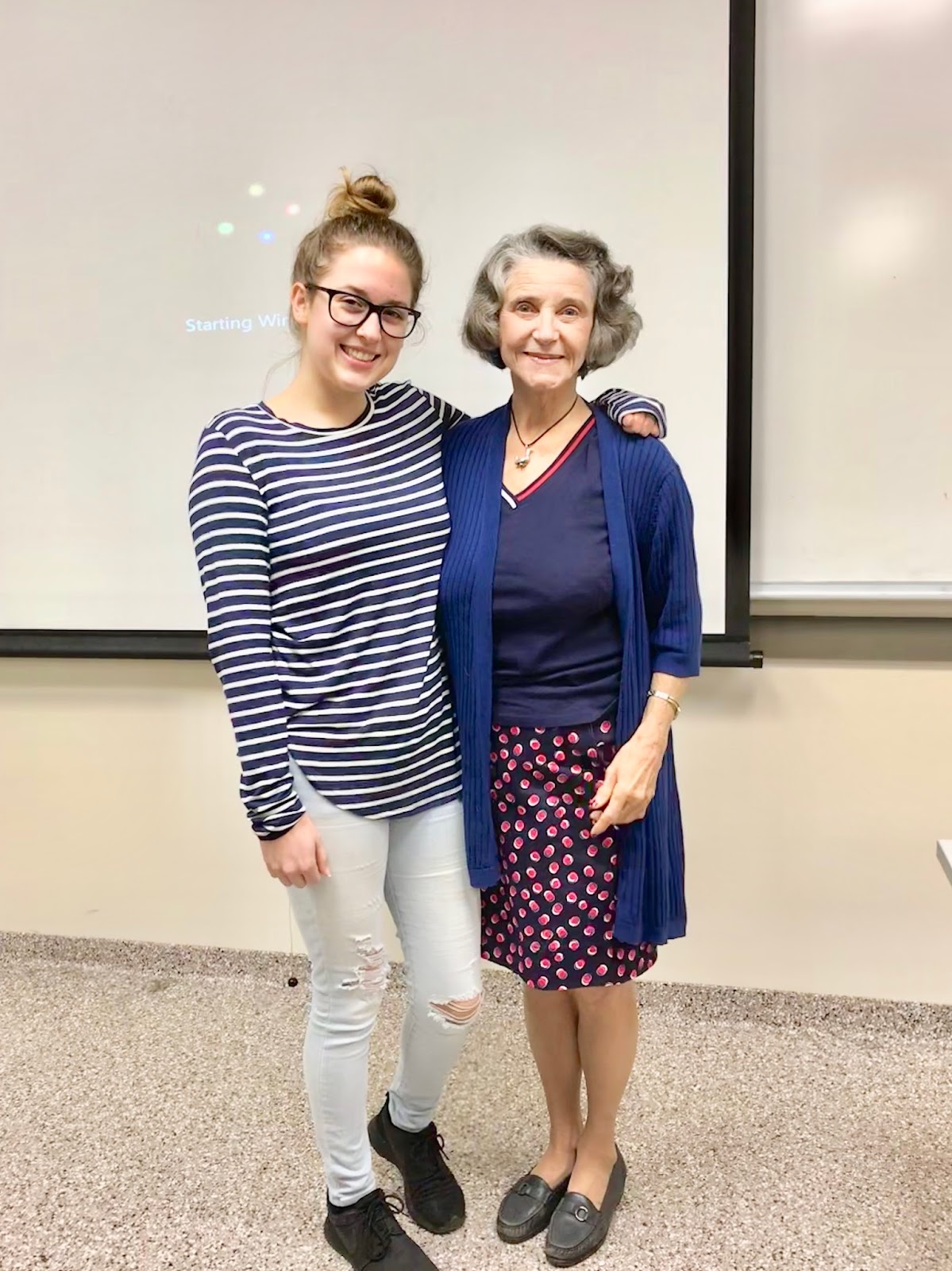
This is a picture of Ruth Miller and I,
after she spoke with us.
Ruth Miller told us, "Tombstones tell a story." This is something that I decided to put into this blog because we are discussing symbolism and grave markers now! It is so cool how each tombstone can be so simple or small, but they really do tell a story! We may not know the details behind what we do see on the tombstones. We can tell that there was effort put into them so we have an idea of who they were, what they did, or represented.

If anyone in Charleston gets the chance to go on one of her tours, take the shot! It was very interesting and I loved hearing from her! She loves what she does and she loves sharing it with others! For more information on her tours, click here!

Monday, February 5, 2018

Entertaining visit to the CofC Library!

Meeting with Jared Seay helped our class learn more about the CofC library page! 5 of the things that stuck with me throughout this visit are listed below. Along with some pictures on our visit!

This is Jared Seay informing us about the
library website and ways we can take
advantage of it!
1. One of the things I thought was interesting about this visit is that there is a website on the CofC library page and its called Special Collections. These special collections show very old maps, texts, etc. that someone may need to use for a school assignment. This can be used digitally, which is newly added to their website, or someone can go to the library, on the 3rd floor, and get access to some older texts they're looking for! 

This is a snapshot of their home page!

2. One thing I learned that I thought was interesting was that there are phone chargers, go pros, computer chargers, projectors, etc. that students can go rent from the circulation desk! Pretty cool!

3. There are also streaming websites that are "similar" to Netflix/Hulu. One of the streaming websites we looked at was Kanopy Streaming Service. This can be used if a student has to watch a documentary or some type of movie that needs to be watched for a class, they can use this website! Interesting that this is a thing at CofC!

This is the Kanopy website shown to us in the classroom!

4. There is a place on the library website that can be visited by clicking the tab that says "Ask Us". There are options that say "Chat With Us", "Meet With Us", and there is a keyword search bar where you can ask questions. I thought this was pretty cool because there is always someone to help when you need it! Through either chatting on the website, or making an appointment with appointment manager.

5. Last but not least, I learned that on the databases search bar, you can filter the search by clicking on the drop down menu and selecting what specific subjects you're trying to search!

The Holy, Historical Visit to Cathedral Church of St. Luke and St. Paul & St. Patrick Catholic Church!

A visit to a graveyard at night? Can't get any creepier than that! Our class visited Cathedral Church of St. Luke and St. Paul and St. Patrick Catholic Church! Most of my pictures taken were from the Cathedral Church of St. Luke and St. Paul, but my last picture on here will be from St. Patrick Catholic Church! Our class was to find 10 different types of grave markers to blog about. The pictures are at night, so they might not be the best quality, but if I got any information out of the grave markers, I put it below the picture! Enjoy!

Ledger


This ledger here was very hard to read, especially at night, but because of all of the cracks and fading of the words. The only thing that was clear to read on this ledger was the first name, Sophia.


Die on Base


This is called a die on base. Again, it being night time was hard to see what exactly was written on the stone, but I got the last name on this one, Vanderhorst.


Box tomb


This one is called a box tomb, one of my favorite ones to look at because it is super creepy looking and interesting as well! Here lays Mrs. Rebecca Thompson and from the picture that I took on my phone, I know her death date is February 26, 1826.


Obelisk


Another one of my favorites to look at is an obelisk. Catherine Porcher is buried here and lived to be 73 years old!


Cross


This cross is so beautiful and was
made for a mother named Maria, born December 27th, sometime in the 1880s, the night time and fading make it hard to read, and I couldn't quite see her death date either.


Mausoleum


This mausoleum is very interesting to me as well because it's huge and it's like a mini house as a memorial for someone. The camera didn't capture the name on the white plaque. 


Headstone


This headstone was very hard to read as well, but the death date on the headstone says February 9th, 1858.


Cradle or Bedstead


Another one of my favorites is the cradle or bedstead. I know the one on the one on the left says Percy Guerard, born on December 14, 1836, died on April 10, 1900, the right says Sue L. Guerard, born on February 4, 1832, to August 3, 1910. 


Column


Now for my favorite, the broken columns! These symbolize that a man's life was cut too short, maybe around the age of 30-40. These are beautiful to me and heart touching. The writing is faded out on this one as well, but I love this one, especially the added flowers at the top of it for more symbolism.


Die on Socket


The last one taken was at St. Patrick Church! This one is called a die on socket. This one says "SACRED / To the Memory of / Miss Margtret M.E. Mahony / Who departed this life December 17th, 1866 / Aged 30 years and 16 days / May her Soul rest in peace." This is very touching and even though it may not be big, it is very meaningful and thought was put into this.

Sunday, January 21, 2018

About me

My name is  Kristina Broome and I am from Greenville, SC. I am not sure what I want to major in right now, but my goal as of now is to talk to my adviser and see what I can do before declaring a major. I want to be successful in life, so I hope I will find a major that both interests me and isn't an average career.

My first semester at College of Charleston was good. I loved meeting new people and I already have friendships that will hopefully last throughout my life!


The Cistern, taken on a night walk.


I also enjoyed the classes I was taking. I ended the semester with a 3.0, but this semester I am aiming for a 3.5, hoping to get all A's!

My time at CofC, I spend at games, studying and working in the library, and try my best to get involved in school activities.

I love spending time with family and friends, watching YouTube, watching Twitch.tv, sleeping and eating!


This is my family on Thanksgiving!

Bittersweet Ending to the Semester!

Graveyard class